Refrigerator Down? Same- or Next-Day Repair in Metro Atlanta
A refrigerator never fails at a convenient moment. It quits during a heat wave or the week you finally stocked up. From then on, the food inside is on a countdown. Emergency Fridge Repair treats a dead refrigerator as the urgent problem it is. We send experienced, EPA 608 certified technicians to homes across Metro Atlanta, usually same- or next-day, to find the fault and fix it on site.
Our phones are answered 24/7. Call (770) 334-4410 or fill in the form on this page with your ZIP code and a few words about what the fridge is doing, and a dispatcher will call you back to set the visit.
24/7 Dispatch Same-Day Where Available
◆ Rather not call?
Request emergency service
Tell us what the fridge is doing and the best number to reach you. A dispatcher calls back to set the visit.
Prefer to talk now? Call (770) 334-4410
Fridge Just Quit? Do This in the First Hour
What you do before the technician arrives decides how much food you keep. These steps take a few minutes and follow USDA and FDA food-safety guidance.
- Keep both doors shut. A closed refrigerator keeps food safe for about 4 hours. A full freezer holds its temperature for about 48 hours and a half-full one for about 24 hours. Every peek lets cold air out.
- Check power first. Look at the plug, try another device in the outlet and check the breaker. A tripped GFCI outlet in a kitchen or garage is a common reason a fridge goes silent.
- Look at the temperature setting. A dial or touch control that got bumped to the warmest position looks exactly like a failure.
- Put a thermometer inside. The fresh-food section should be at 40°F or below and the freezer at 0°F.
- Move what matters most. Medicine, baby formula and expensive cuts go into a cooler with ice first.
- Clear the way. Make room in front of the refrigerator and on the floor beside it, so the unit can be pulled out if the technician needs the back panel.
If the food has been above 40°F for longer than the times above, the USDA advises throwing out perishables such as meat, dairy, eggs and leftovers. When in doubt, throw it out.
What We Fix
Freezer Repair
upright, chest and garage freezers that stopped freezing.
Ice Maker Repair
built-in and refrigerator ice makers with no ice or slow ice.
Wine Cooler Repair
single- and dual-zone wine refrigerators that drift warm.
Oven Repair
gas and electric ovens that will not heat.
Stove & Range Repair
ranges, burners and cooktops.
Restaurant and business refrigeration is described on our home page.
How an Urgent Call Works
Step 1 — You call or send the form. A person answers, day or night. We ask for the brand, the symptom, how long it has been going on and your ZIP code, then give you the earliest visit window we have, usually same- or next-day.
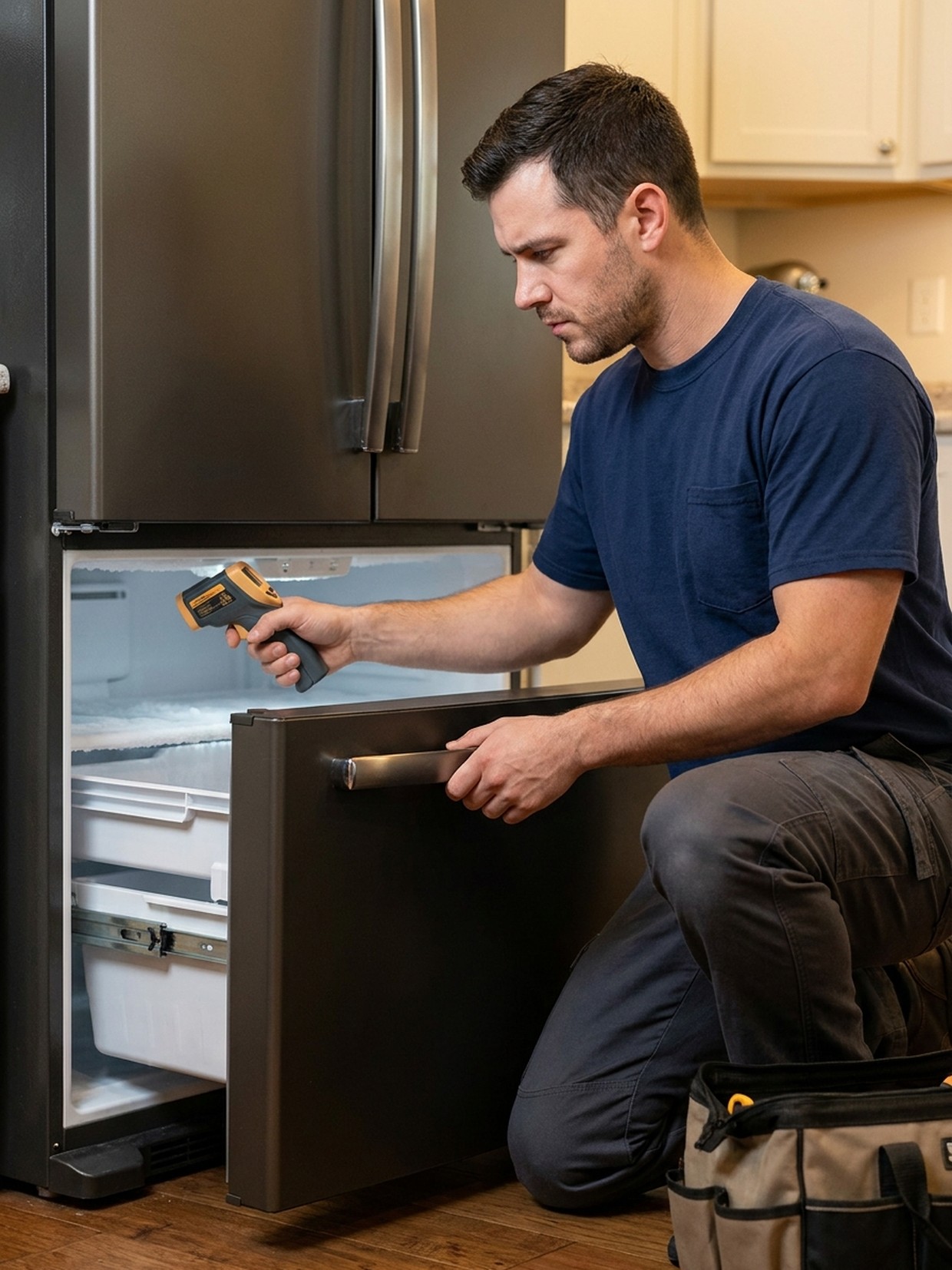
Step 2 — The technician diagnoses on site. We measure temperatures, listen to the compressor and fans, look at the condenser, check the defrost parts and test the controls. You hear in plain words what failed and what the repair involves, and you decide whether to go ahead before any work starts.
Step 3 — The repair and the test. The failed part is replaced with a genuine or OEM-approved part. The technician restarts the refrigerator and watches it pull temperature before leaving. The work carries a warranty of up to 6 months on parts and labor.
What the Technician Checks
A refrigerator is several systems that depend on each other. One weak link can make the whole unit look dead.
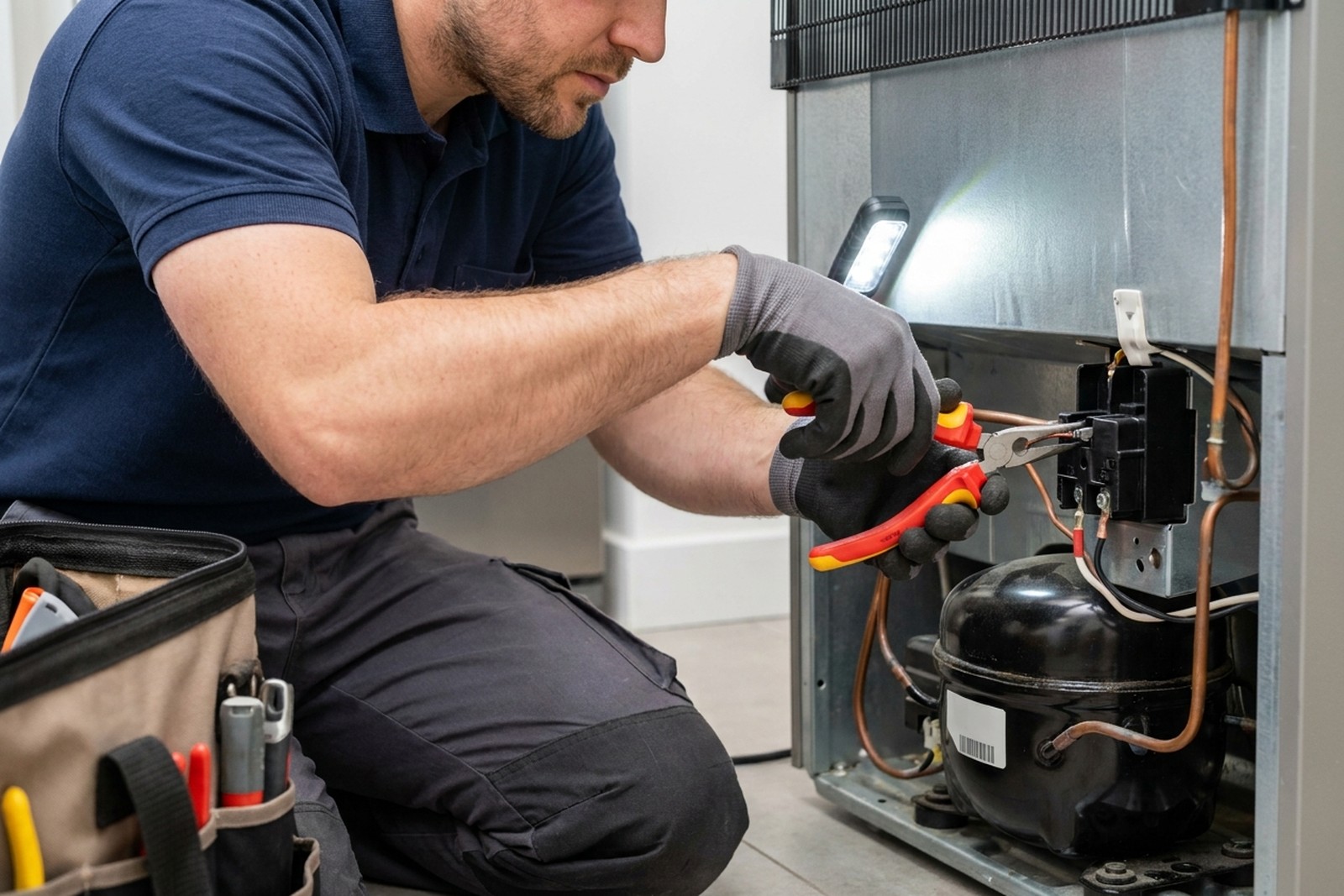
The sealed system. The compressor moves refrigerant through the condenser, where heat is released, and the evaporator, where the cold is made. Only EPA 608 certified technicians may open this system and handle refrigerant, and every technician we send holds that certification.
Airflow. The condenser fan cools the compressor area; the evaporator fan pushes cold air through the freezer and into the fresh-food side. One stopped fan can warm a refrigerator in a day.
Defrost. The defrost heater, the defrost thermostat or sensor, and the timer or board that runs the cycle melt frost off the evaporator coil several times a day. If one of them fails, ice builds slowly and the cooling fades over several days.
Controls. Thermistors report temperatures to the main board, and the board decides when the compressor and fans run. Many newer LG and Samsung refrigerators use variable-speed compressors driven by their own inverter board, which takes model-specific testing.
Water and ice. The inlet valve, the filter housing, the water lines, the ice maker and the dispenser.
Doors. Gaskets, hinges and door switches. A worn gasket lets humid air in and loads the coil with extra frost.
Refrigerators We Work On
- French-door models with bottom freezer drawers and ice makers in the fresh-food section.
- Side-by-side refrigerators with through-the-door ice and water.
- Top-freezer and bottom-freezer refrigerators, the workhorses of rentals and older homes.
- Counter-depth and built-in units, including panel-ready models set flush with the cabinets.
- Garage and basement second fridges, which work hardest during Georgia summers.
Brands We Service
We service most major refrigerator brands, from everyday models to high-end built-ins: Samsung, LG, GE, GE Profile, GE Café, Whirlpool, Maytag, KitchenAid, Frigidaire, Electrolux, Kenmore, Bosch, Haier, Amana, Sub-Zero, Viking, Thermador, Monogram, Jenn-Air, Liebherr, Miele, Fisher & Paykel and U-Line. Our technicians have worked on these refrigerators for years.
Emergency Fridge Repair is an independent, family-owned business. We are not affiliated with or endorsed by any appliance manufacturer, and brand names on this page only describe the refrigerators we repair.
Repair It or Replace It?
For most refrigerators, repair is the sensible choice. Fans, relays, sensors, defrost heaters, valves, gaskets and control boards are replaceable parts, and a single part is a small fraction of what a new refrigerator, delivery, installation and haul-away add up to.
Replacement starts to make sense when an older refrigerator has a failed compressor or a refrigerant leak inside the insulated walls. If that is what we find, we say so plainly and give you the facts to decide, even if it means there is no repair to do.
Keep the Next Breakdown Away
- Vacuum the condenser coil every six to twelve months. On many models it sits behind the bottom grille; on some built-ins it is at the top.
- Give the refrigerator room to breathe. Follow the clearances in the manual, especially for a freestanding fridge pushed into a tight cabinet.
- Replace the water filter on the schedule your manual gives.
- Test the gaskets. Shut the door on a dollar bill. If it slides out with no drag, the seal is worn.
- Keep vents inside clear. A crowded shelf in front of the air outlet can warm the whole section.
- Watch the garage fridge in July and in hard freezes. Many standard models are not built for unheated spaces.
Where We Work
We cover homes across Metro Atlanta, including Atlanta, Marietta, Sandy Springs, Roswell, Alpharetta, Decatur, Smyrna, Dunwoody, Brookhaven, Duluth and Johns Creek. Enter your ZIP code in the form to see whether your address is inside our area.
Office for refrigerator calls: 3939 Roswell Rd NE, Marietta, GA 30062.
Call Before the Food Is Lost
The sooner a technician sees the refrigerator, the more food you keep. Call (770) 334-4410, a person answers 24/7, or send the form and a dispatcher will call you back to set a same- or next-day visit.
Warning Signs We Hear About Every Day
These are the calls we get most, in homeowners' own words. Each points to a different system, so we diagnose instead of guessing.
"The fridge is warm but the freezer still feels cold."
In most refrigerators the fresh-food side is cooled by air pulled from the freezer. A frozen evaporator coil, a stopped evaporator fan or a stuck air damper cuts that flow while the freezer keeps working.
"Everything is warm and the light still works."
Power reaches the cabinet, but the cooling system is not running. A failed start relay, a stopped condenser fan, a dirty condenser coil or a control board fault are the usual suspects.
"It clicks every few minutes, then goes quiet."
The compressor is trying to start and an overload is shutting it off. That is often a start component, not the compressor itself.
"There is water under the fridge."
A blocked defrost drain, a split water line to the ice maker or a leaking inlet valve. Water on the floor next to an outlet is a reason to call right away.
"There is a sheet of ice on the back wall of the freezer."
The automatic defrost has stopped. Frost keeps growing until air can no longer move.
"It is louder than it used to be."
A fan blade hitting ice, a worn fan motor or a compressor working much harder than normal.
"The ice maker stopped and the water dispenser is slow."
A clogged filter, a frozen fill tube, a failed inlet valve or a line frozen inside the door.
"The outside of the cabinet is sweating."
In humid Georgia summers this can be a torn door gasket or a failed heater that keeps the cabinet edges dry.
"The display shows a code."
Write it down before you call. A code narrows the search and can shorten the visit.
Emergency Fridge Repair
Why Atlanta Households Call Us
Same- or next-day visits — For a refrigerator that has stopped cooling.
A person on the phone 24/7 — So you can book the moment you notice the problem.
EPA 608 certified, background-checked technicians — For sealed-system and refrigerant work.
Insured work — Done inside your home.
Genuine or OEM-approved parts — Chosen for your exact model.
Up to 6 months of warranty on parts and labor — Backed by 15+ years of refrigeration experience at a family-owned company.
Emergency FAQ
Refrigerator Repair FAQ
How fast can a technician get to me?
Across most of Metro Atlanta, the visit is same- or next-day. Calling early in the day gives you the best chance of the earliest window. Our phones are answered 24/7, so you can book at any hour.
Is food in a warm refrigerator still safe?
According to the USDA, food in a closed refrigerator stays safe for about 4 hours. After that, perishables that have been above 40°F should be thrown out. A full freezer holds for about 48 hours and a half-full one for about 24 hours.
My freezer works but the fridge is warm. Is it the compressor?
Usually not. A freezer that stays cold tells us the compressor is running. The problem is more often frost on the evaporator coil, a failed evaporator fan or a stuck damper.
Why is my refrigerator clicking and not cooling?
A click every few minutes usually means the compressor is trying to start and shutting off. A failed start relay or overload is a common cause, and it is a much smaller repair than a compressor.
Can I defrost the freezer myself to get it working?
A manual defrost can bring cooling back for a few days, but the frost returns if a defrost part has failed. Never chip ice with a knife or screwdriver: it can puncture the coil.
Do you repair ice makers and water dispensers too?
Yes. Inlet valves, filters, water lines, ice makers and dispensers are part of refrigerator repair. See our ice maker repair page for more.
How long is my refrigerator repair covered?
Up to 6 months on parts and labor, with genuine or OEM-approved parts.
Are you connected to the refrigerator manufacturers?
No. We are an independent, family-owned repair company. Brand names appear only to show which refrigerators we work on.
◆ Where we work
More repair pages
Services
Freezer Repair Ice Maker Repair Oven Repair Refrigerator Repair Stove & Range Repair Wine Cooler Repair
Commercial
Commercial Ice Machine Repair Display Case Repair Prep Table Repair Reach-In Refrigerator Repair
Cities
Alpharetta Austell Avondale Estates Brookhaven Buford Canton Cartersville Clarkston College Park Conley Conyers Cumming Dacula Decatur Duluth Ellenwood Fairburn Fayetteville Flowery Branch Forest Park Gainesville Grayson Hampton Johns Creek Jonesboro Kennesaw Lawrenceville Lilburn Lithonia Loganville Mableton Marietta Milton Morrow Newnan Norcross Peachtree City Peachtree Corners Pine Lake Powder Springs Rex Riverdale Roswell Sandy Springs Scottdale Smyrna Snellville South Fulton Stockbridge Stone Mountain Stonecrest Suwanee Tucker Union City Woodstock
Your fridge can’t wait — call now for a same- or next-day visit.
Refrigerator, freezer and commercial refrigeration repair, by experienced EPA 608 certified technicians. Phones answered 24/7.
Call now — (770) 334-4410